Spar-tid-og-penge-med-automatisk-fragt--og-ordrehaandtering2

Save paper and labels – A sustainable solution at Webshipper

Picture of Jonas Raaschou

Jonas Raaschou

Content Manager

At Webshipper we do everything we can to make our solution so easy and automated for our users.
Our customers save both time and money with automation.

There are often errors when you have to manually enter and copy your order information to the relevant shipping carrier.

An error may mean that the carrier cannot accept the package, that the package is not delivered at the right time and place, or for any other reason ends up returning to the company. In addition to unsatisfied customers, this also means a repackaging in the warehouse and another round of papers in the form of labels, etc.

Webshipper offers an automated solution that saves time and saves paper use. Who wouldn’t want to be just a little sustainable?

Automatic label printing

With a Webshipper label printer, your system is set up to retrieve all data from your order. This way, your pick lists, leaflets, or package labels will not fail.

Should there be an error in the order you will be notified online before printing. Order errors can be, for example, if the customers address or mail is not valid. (This can be set up in most webshop systems, so only valid addresses and emails are accepted)

Paperless customs

If you ship outside the EU, we can also provide automatic paperless trade (customs documentation).

If it is new to you to send abroad, remember to add tariff numbers to all products in your webshop and choose for your checkout which countries you want to send to.

Practically, Webshipper retrieves the order with customer information, tariff numbers and recipient country. Then a PDF is generated with all information that is automatically sent to the carrier.

Not all transporters support paperless trade yet. So check with your carrier – can they receive paperless trade, simply inform them if you want to use it over physical documents.

Online return portal

In the system we also offer your customers that they can return online. This means that your customers can login with their mail and order number. Here they can see all the items on the order, choose which item(s) they want to return and why. Eventually, they can choose whether they want to exchange for a new or get their money back.

Once the customer has gone through all the steps, he/she will receive the return label in their mail.

You can see an example here as well as see how to set up your return portal.

Signup_Tips_Tricks

Get Tips & Tricks directly in your inbox

We continuously update our website with Tips & Tricks in the form of blog posts, video and podcast.

Sign up and get notification when we have Tips & Tricks for you. 

Hvad-er-papirloes-told2

Paperless Customs

Picture of Jonas Raaschou

Jonas Raaschou

Content Manager

Create and handle your customs documentation digitally through Webshipper and discover how your shipments clear customs faster and more efficient. By implementing this affective and straightforward solution, you will avoid delays and deliver international shipments by time.

Paperless customs enables you to create and send electronic invoices. The service is free and eliminates the need to print and enclose physical documentation in the package. The benefit is less time spend on documentation and a reduced environmental impact.

Paperless customs have many designations, but the most used ones are; Paperless Customs, Paperless trade, Paperless invoice, and Electronic trade documents.

The benefits of Paperless Customs

There are several advantages to using paperless trade when shipping paperless outside the EU. It is essential that the customs authorities, in the Country concerned, can charge the correct amount. The customs documentations need to contain the following information; HS code, Country of origin, and unit price.

Usually, the customs clearance is manually calculated based on the enclosed invoice. However, paperless trade cuts that process away, which results in faster delivery times because the shipment is sent directly to the receiver. No more waiting for the parcel to clear customs – the customs are charged automatically.

It is easy and straightforward to set up paperless trade in the Webshipper app. Although you need to have paperless initiated in your contract with the carrier – but that should be straightforward as well and online within 24 hours after activation.


Ship paperless with DHL Express

It is essential to sign up for paperless trade in your DHL Express contract. Contact your DHL account manager to get paperless activated. After activation, all you need to do is to toggle paperless on in the Webshipper Platform. Read more here [External link]

Ship Paperless with UPS

At UPS, the product is called Paperless Invoice, and the procedure is basically the same. It’s free, and you can be up and running within 24 hours. Send a photo of your letterhead and your signature to get started, click here to read more and sign up for UPS paperless. When enabled at UPS, you can allow paperless in Webshipper with a few clicks.

Ship Paperless with FedEx

FedEx Electronic Trade Documents. FedEx allows you to create electronic customs documents. It’s super easy to set up. Remember to have paperless activated in your contract with FedEx. Following that, you can toggle paperless on and off with a single click on the Webshipper platform.

Now you should be ready to start shipping internationally. If you have any questions regarding your setup and paperless, don’t hesitate to contact our support team.

DAO-labelles2

DAO Lableless

Picture of Jonas Raaschou

Jonas Raaschou

Content Manager

DAO delivers parcels 24/7, including public holidays all year round.

Time is paramount when it comes to parcel delivery; that’s why it is necessary to transform delivery into an efficient and straightforward process, for both business and consumers. 

“Every night, 3,500 DAO messengers drive more than 100.000 kilometers to deliver newspapers, parcels, or your favorite magazine.”

Dao offers a new feature “DAO e-label”

Instead of sticking a shipping label to the parcel, all you need to do is write a nine-digit number on the parcel and drop it off at a DAO-Shop – Ingenious.

This solution has, of course, been implemented in Webshipper, meaning it is available for booth shipments and in our return portal. We are allowing you to give your customers a great and flexible shopping experience.

Labelless online return portal

Customers can quickly return products through the Webshipper return portal.

In a nutshell: you no longer have to force customers to print return labels themselves.

Once the online return portal and DAO e-label is ready and online, the customer will receive a return confirmation containing the nine-digit labelless code.

Now: The only thing left is to use recyclable return packaging to offer an easy solution for the customers while you save a few precious recourses. 

The nine-digit shipping code should only be written with a waterproof touch or pen on paper or cardboard. 

DAO uses the nine-digit E-LABEL code to identify the shipment and ship it to the correct address.

It is essential to follow these guidelines:

  • The numbers should be clear and readable
  • Write the code with a waterproof tush or pen.
  • Write the code on paper or cardboard, not plastic.

Do you need any help for setting up DAO e-label, you are welcome to contact our support: contact us oread the support article here.

Signup_ProductNews

Get Product News directly in your inbox

We continuously update our website with Product News in the form of blog posts, video and podcast.

Sign up and get notification when we have Product News for you. 

Introducing Zapier for Webshipper

Picture of Jonas Raaschou

Jonas Raaschou

Content Manager

Zapier is a global company that allows an end-user to integrate the web applications they use and love. Zapier is located in Sunnyvale, California, and employs more than 100 people in 24 countries.

Zapier allows the user to automate web applications together and is often described as a translator between APIs.

Now there is a Webshipper application ready for Zapier, meaning that Webshipper users can automate their tasks and connect Webshipper to more than 2.000 apps or vise versa.

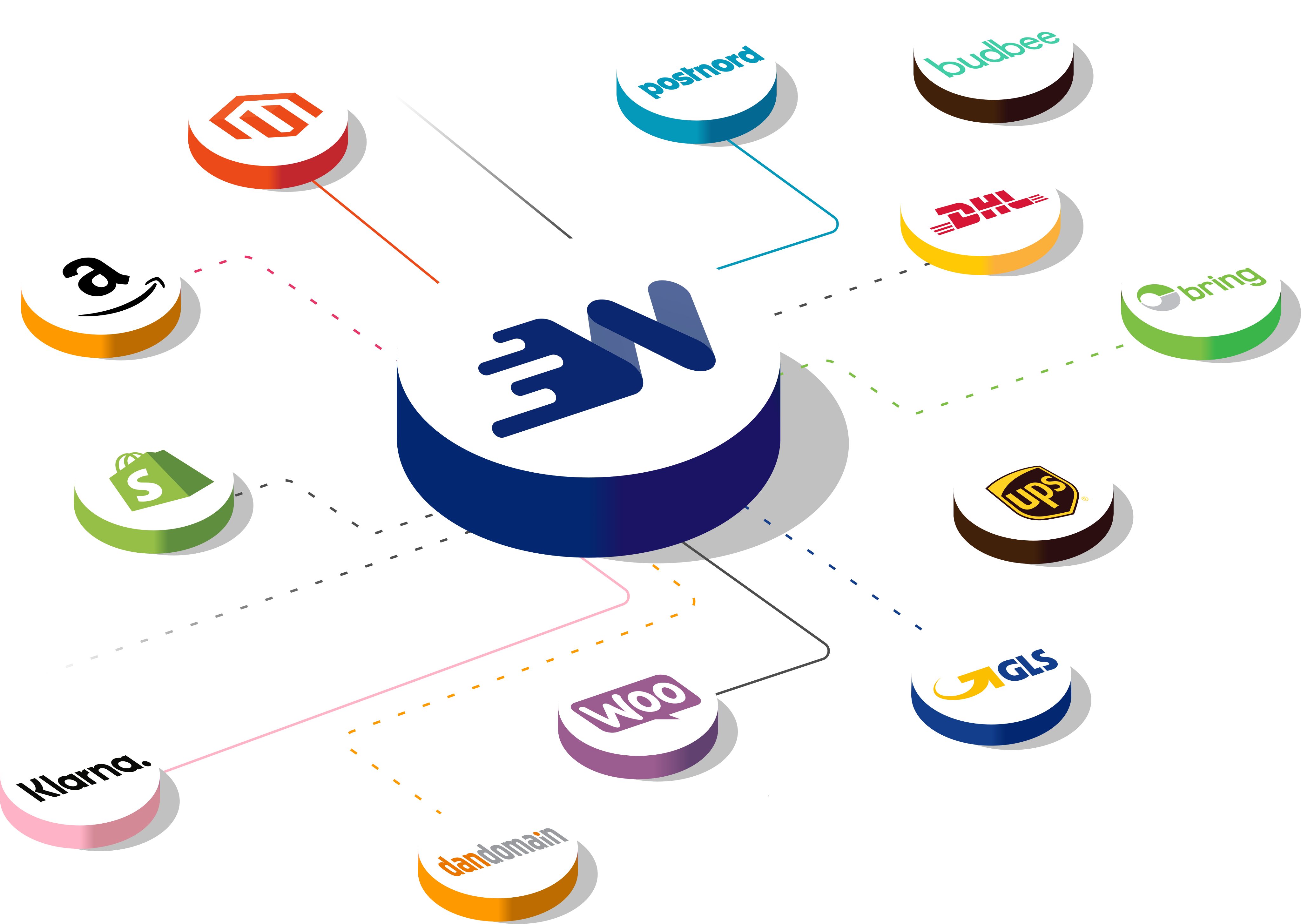
At the moment (23/07-2020), Webshipper has more than 30 native and third-party integrations, but with the release of Zapier the number has risen to more than 2.000. We appreciate that not all applications are relevant. Still, the world has opened up for endless integrations that allow for even more combinations and possibilities.

Still, not sure how Zapier and Webshipper can be used in real life?

The core functionality ion Zapier is to move a set of data from one system to another, process it, and send it back. Or maybe all you want is to send data from one system to another. 

As I said, the possibilities are almost endless when it comes to Zapier!

Zapier is built around triggers and actions, making it possible to perform actions based on specific triggers. The triggers and activities are all different and independent of each app. 

Webshipper integration has four triggers and two actions, which lets you pull or add data from Webshipper when specific actions are triggered.

Webshipper x Zapier

Let me give you a quick example of how the integration can be used!

At the moment, Webshipper doesn’t support BigCommerce e-commerce platform, but with Zapier, it does. BigCommerce has a trigger that allows for the order to be transferred to Webshipper. When an order is placed in BigCommerce, Zapier then creates the order or shipment in Webshipper. 

But what about your favorite ERP-system, Magento or WooCommerce, or even Shopify. They all have Zapier integrations that can do the same, and much more.

Here are e few examples of how you can use Zapier and Webshipper together

WooCommerce is an e-commerce module for WordPress, the combination is one of the most used e-commerce systems worldwide. Webshipper and Zapier allow for the synchronization of shipments, customers, orders, and it is even possible to create coupons based on orders.

Transfer order details to google sheets, and create CSV-files, process data and send it back to Webshipper. Google sheets is hosted by Google and a fantastic cloud-based alternative to Microsoft Excel.

Mailchimp is one of the most used platforms for sending news mails. Add your customers to Mailchimp ad send emails based on purchase, zip codes, or something else. 

Amazon is the world’s biggest online marketplace, with Zapier, it is now possible to transfer Amazon orders directly to Webshipper and ship orders worldwide, with a single click. 

Visma eAccounting is a popular accounting software in Norway. Transfer orders from Visma and print shipping labels with a single click through Webshipper.

Those examples are a drop in the ocean. Zapier has an extensive library of all combinations which you can find right here.

Our customers find it very useful. Other popular Zapier integrations are:

  • Create shipment in Webshipper based on orders in ERP-systems
  • Receive message in Slack, Mail, or SMS when an order is placed.
  • Transfer orders to Google Sheets when an order contains a predefined value, such as dangerous goods, weight, type, location, or something else.
  • Add customer purchase history to HubSpot
  • Add customers to email marketing platforms such as Mailchimp.

The Zapier library is continuously growing, and we would love to hear how you use Zapier and Webshipper together. Throw us an email, and we will share your story.

Tracking-som-marketing-2

Tracking E-mail as a Marketing Platform

Picture of Jonas Raaschou

Jonas Raaschou

Content Manager

Due to the large amount of adds we are exposed to on a daily basis, more and more people decide to use add-blocks or even percolate sales and marketing-mails.

In Denmark we expect to receive a tracking mail as soon as our package has been sent, in order to trace the package to have an idea of delivery. 

tracking mails are not only important but also the types of mails that have the highest open rates – which many open several times in order to check up on their packages. 

So why not take advantage of your content in your tracking mail?

Depending on which type of product you are selling, there are pros and cons in relation to adding further content in your tracking mail.

Mails should be short and precise, in order to make sure that the customer reads the most import part of the mail or clicks on a specific link. 

But would it not be awesome if the customer would return – Or even rate you on Trust Pilot?

Use your tracking mail for marketing

First of all, you have to remember that tracking information still needs to be flagrant. Next, you can add your wanted message.

Retargeting

For instance, you can run a retargeting campaign that shows which products he or she has been looking at, or related products for the purchase.   

there is a fine line between too much and too little. Depending on your products and prices, retargeting can be and incredible tool that quickly and easily pushes your customers towards further purchases, since they already  have shown an interest in your product.

There are different ways to handle retargeting campaigns:
1. Brand targeting: You will be visible and create brand awareness.                   
2. Product retargeting: You will show relevant products and reactivate your customers. 
3. Video retargeting: You will show or tell a story or show new relevant products. 

Discount Codes and Special Offers

Furthermore, you can offer a discount code. Discount codes can be an advantage since you encourage your customers to shop again – then of course, you will need to back it up with your amazing customer service in relation to their current purchase. 

You can define the discount code whether it needs to have an expiring date or to how it fits into your exact marketing strategy. 

Competition or gamification

You can also take a more alternative approach – contests or gamification. Gamification is the new black within online marketing. In most mailing systems you can integrate competitions and gamification, where your costumers will have the opportunity of winning a price by integrating even more. 

Social media and the development within online shopping has heighten expectations for our customers, why it can be a great advantage to lure your customers to re-buy through prizes.

Does it sound like something that would fit your webshop, then check out the large selection of fun and efficient gaming concepts at LeadFamily who are experts within online gamification. 

Rating and TrustPilot

Last of all there is the most employed – rating of customer shopping experience. A large range of webshops and online businesses are hooked up to TrustPilot. Customer evaluation and online safety is, as most people know, important to secure customers plus a revisit. 

Therefore, the classic rating evident to place in your tracking mail is evident to place in your tracking mail. Either the first mail or your delivery confirmation, in order for your customers to rate their experience while it is fresh in memory.

… And make sure that the mail is send from you – not TrustPilot. 

So, What to choose? 

Make sure that you only use one of above at the time. As said earlier – do it precise and short, so you make sure your customers gets the message. 

Be creative.

En-guide-til-norsk-VOEC2

A guide to VOEC – VAT on E-Commerce in Norway

Picture of Jonas Raaschou

Jonas Raaschou

Content Manager

In the new e-commerce scheme, non-established suppliers and online marketplaces are liable to account for VAT on sale of low value goods to Norwegian consumers. The scheme affect B2C sales of low value goods below 3.000 NOK If annual sales to Norway excited NOK 50.000.

The New obligations and reporting

Foreign companies selling goods to Norwegian consumers online will be obligated to register for VAT in Norway from the 1st of April 2020. The simplified registration for these entities is called VOEC (Valued Added Tax on E-Commerce), and is based on the existing legislation for electronic services.

What does it mean to me as a reseller?

A consequence of the new rules is that the previous CAT exemption for import of goods with a value below NOK 350 is abolished. The VOEC scheme shifts the obligation to calculate, collect and pay VAT to the seller. Goods that are compromised by this new legislation are also exempt from customs duties which makes it potentially profitable for certain suppliers.

VOEC is not mandatory, meaning that you can use the ordinary VAT registration system in Norway to fulfill VAT obligations in Norway instead.

How to register under VOEC

  • Charge Norwegian VAT at the point of sale (checkout)
  • Mark the shipments with your VOEC identification number
  • Report and pay Norwegian VAT quarterly

Don’t worry, there are plenty of advantages to VOEC scheme compared to ordinary TAX registration

  • Clothes and textiles are subject to customs duties in Norway, while goods within the scope of the VOEC scheme are exempt.
  • Shipments imported through the VOEC registered companies will not be subject to customs declaration – making delivery times faster.
  • The consumer avoids tax and custom duties upon arrival.
  • Simple tax settlement with the Norwegian tax authority. 

Should I register for VOEC?

  • VOEC is only applicable for sale of goods below NOK 3.000. This means per item not per invoice or consignment
  • You are as a seller required to label the packages with your VOEC identification number.
  • If you choose not to register will the Norwegian consumer be obligated to pay VAT and a custom fee around NOK 150 with a slower delivery as a consequence.

How can Webshipper help with VOEC?

We recommend applying for VOEC if you ship to Norway. If you ship single packages from an e-commerce shop the advantages are more than enough to register. Webshipper provides a solution that are capable of reporting your VOEC identification number, which excludes your shipments from custom duties. The Norwegian authorities will charge the VAT every quarter based on the reporting made through the customs feature. You can add your own VOEC identification number, or make a clever automation that automatically adds the VOEC number to the consignment when it meets certain requirements.

Interested? Contact support and get started with automatic VOEC now. Or read the support article. The Norwegian tax authorities has a complete guide on VOEC as well.

Want to know more about shipping in Scandinavia you can read the guide here

Otherwise, you can read more about Brexit and customs declarations. 

Bliv-klar-tiljulehandely2

Get ready for Black Friday

Picture of Jonas Raaschou

Jonas Raaschou

Content Manager

The importance of Black Friday is increasing throughout Europe, and the increase is more visible than ever in physical stores as in e-commerce. 

We have followed our customers throughout the last 4 years and experienced a development in different lines of businesses.  

So how are you able to exceed your competitors?

How do you prepare yourself for Black Friday?

And how do you get through without being in a pickle?

We do not have the right solution for your exact shop, but we are happy to share our knowledge.

  1. Use last years data
  2. Landing page
  3. Is your server ready?
  4. Set up your stock and prepare your employees
  5. Market all the way! 
  6. Optimize your returning process 
  7. Lifeline – make sure to get through to your partners (Webshipper, webshop system, payment system)
  8. FAQ

1. use data from last year 

If you have had your webshops for several years, you should use your former data to estimate visits on your website, expected revenue plus popular sales. 

Furthermore you can check:

  • Which searches made people last year on your website?
  • Which products performed well?
  • Check Google Trends for search categories 
  • Look out for your competitors 

2. Landing page 

Create a landing page in order to lead your Black Friday traffic in a safe and steady manner. In that way you will be able to control what your customer will be exposed to, by collecting all of your offers on one single page. This will create a perfect overview for your customers. Make sure to clarify your customers exact savings plus, which type of discount it may concern. (%, discount, variation of products)

3. Is your server ready?

Make sure that your server is able to accommodate visitors. No one wishes to wait for a webshop to open if a breakdown should occur – So please make sure to have enough server capacity.

4. Set up your stock and prepare your employees 

Make sure that your stock is acute and ready for all the orders that drop in – this also involves your stockstatus/ supply. The worst customer experience is to now have the products in stock. Let us please avoid this specific situation. 

Furthermore, it is important that your employees are thoroughly informed regarding duty schedules, breaks, procedures and routines in order to make the best experience for everyone. To make the day a bit more pleasant, you can spice things up by providing candy, beverage and so on. 

5: Market all the way! 

Make sure to be as visible as possible as opposed to your competitors. Use Facebook, Instagram and GoogleAds as far as possible in relation to your shop and target group. 

You can, with advantage, set up a facebook event for Black Friday 2-3 weeks in advance. In that way, you can collect leads in order to target your Black Friday campaigns. 

Be aware of the following when setting up your event:

  1. A catchy title that describes how you are making something extra
  2. Date and time
  3. Type of offers (offers per hour or per day)
  4. Special offers (free shipment, goodie bags for the first 100 or all customers)
  5. Other practical issues (extended delivery can occur due to many orders)

6: Optimize your returning proces 

Is it possible to optimize your return flow, then do yourself and your customers a favor. the simpler it is for everyone, the better a customer experience you will offer. 

Should you for instance offer free returns potentially over a certain amount?

Should your customers receive a return label with their parcel, or should they collect it online?

Perhaps, your carrier has a solution to which your customers should not have to use a label but instead be content with a code. 

Furthermore, you need to keep track of your process within return labels, in relation to when your stockroom receives products in return.  

How fast should it be registered in your shop, enabling it to sell to a new customer? 

And how can you and your employees manage in a manner so you will not have your returns mixed with new products – and do not forget to check when it comes to claims.  

Read more about online returns and how to create value for both you and your customers here.

7. Keep track of your lifelines!

Should anything go wrong, contrary to expectations, make sure to keep track of your lifelines. 

Do you have a backup of your payment system if it should crash?

Unfortunately, it has occured that payment services have crashed, so make sure to have your contact information on the responsible service at hand. And not least, make sure to check up on in which span they can be contacted.   

the same goes for your other partners, if you have anyone to manage your webshop and website. Should the unfortunate happen, then be certain that you are able to contact your partners, and have a plan at hand if a crash or a breakdown should happen. 

Do yourself a favor and spend some time on creating an emergency plan and contact list. 

8. FAQ

Q: How do I make sure that my stockroom can keep track?

A: Set up one or more printing- and packing stations. In that way you make sure that your employees have enough space and do not have to wait on line to print out orders.


Q: Subsequently, my carriers have sent expensive bills, why?

A: Estimate your volume to your carriers, so you make sure to have the correct shipping prices. have a dialogue with your carriers in advance. In that way you will avoid unexpected bills.  


Q: What if anything breaks down or crashes?

A:  Webshipper supports your checkout, which means that you are not reliant on your carrier’s server. But make sure, as mentioned in section 7, to be in charge of your lifelines. 


Q: Can my webshop keep up?

A: We specialize in shipping and logistics, which means that we let your partner be a specialist within their field of expertise. Contact your partner early, so you make sure that your webshop is able to handle the Black Friday pressure. All webshops have been set up differently, so make sure that your webshop solution has been set up to your expectations.

5-huller-i-din-e-mailmarkedsfoering2

5 gaps in your email marketing

Picture of Jonas Raaschou

Jonas Raaschou

Content Manager

Why is email marketing so important for webshop owners?

Because an email has an average ROI of 44 (https://sleeknote.com/email-marketing-roi-tool). If you invest 1 Danish krone in email marketing, that Danish krone will return to you 44 times.

This ROI is much higher than those of SEO and social media.

Heyloyalty knows all about that. This marketing automation company helps businesses such as Bog & idé and Sport24 to improve their email marketing performance. Some of Heyloyalty’s customers gain 50% of their income from emails.

We spoke with Heyloyalty’s marketing manager, Ole Dalgas. He revealed five gaps in email marketing where you risk losing warm leads – and how to close these gaps, so you get happy customers instead.

1.     You don’t collect enough data from your subscribers

If you collect subscribers via a sign-up box on your website, it probably looks like this box at Bertoni.com:

Bertoni asks only for your email address in return for the right to send you newsletters. And that’s fine, Ole says – but there’s an important ’but’:

”Research shows that when you ask for more information besides name and email address in the sign-up process, people opt out. The conversion typically drops by 50% for each new piece of information that you ask your new subscriber to provide. But you should get more subscriber data beside name and email address in order to segment your newsletters. Readers don’t mind receiving more newsletters if it’s relevant for them. An example: the Danish drugstore brand Matas could segment on gender, so they know if they should send you an offer of an Elizabeth Arden perfume or a Hugo Boss deodorant. It would be useful for the Danish DIY centre Silvan to know if a new subscriber lives in an apartment or not, so they don’t send offers on sandpits.”

But if you shouldn’t ask for more data in your sign-up box, how should you collect more data on your subcribers?

”Be sure to have an automated welcome flow. Ask your subscriber to fill in more data in your second or third email in that welcome flow,” Ole recommends. ”Use this data to segment your subscribers into groups, in order to send them even more useful content. Useful content determines whether or not they stay on your email list.”

2.     Your welcome flow isn’t good (enough)

When someone opts in to your email list, it’s important to give them a warm welcome.

”A welcoming email is the first email your new subscriber gets from you. Such emails typically have a very high open rate – about 80–90 %. You should repeat your offer in this email; for example, a code to get 10% off a first purchase, free shipping, free returns, or whatever you’re offering,” Ole recommends. ”Just because they subscribe to your email list, it’s not certain that your customers remember all of your benefits. An example: Djurs Sommerland offers tons of benefits to its season ticket customers, but they probably never use all of these benefits.”

Support your new subscriber’s decision to subscribe to your newsletter. Send useful advice or special offers in order to make the first sale. The amazing thing about a welcome email flow is that you have to plan and write it only once. After that it will run automatically.

3.     You forget to use Google Analytics

Too many webshops don’t prioritise logging in to Google Analytics regularly. That’s a huge mistake, according to Ole Dalgas:

”Via the Google Analytics code on your site, you get tons of useful information. You’ll know where visitors click and where they don’t. It will help you find out precisely what sales volume your newsletter generates – and that will help you decide whether or not to spend more time writing newsletters. When I recommend people use Google Analytics, I tell them to get better customer data in order to set realistic goals. The same applies for the statistics in your email marketing systems.”

So, make it a habit to check Google Analytics regularly. If you’re not sure how to read the numbers, there’s a lot af help online. Ole recommends:

  • Google’s own Google Analytics Academy (free).
  • the Danish online marketing portal GoLearn (DKK 299 per month).
  • asking questions in groups on social media where marketing and communications professionals are ready to help each other.

4.     You send too few newsletters

In a Heyloyalty study of 60 webshops, almost half sent a newsletter only once a month. If you don’t send more emails than that – and if you don’t segment your emails – it’s hard to keep and engage your customers.

”People are afraid to send too many newsletters – what if people opt out? But provided only 5–8% of your subscribers opt out, you could send more emails. Don’t send irrelevant content. But people can handle more emails if they’re relevant, with offers on exactly the product they’ve been waiting to buy.”

Send more newsletters than you do now, preferably one email per week, or more during campaigns – and even more with the help from automatic triggers activated by customer behaviour and purchases.

But how will you find the time to write those newsletters? This question leads us to the fifth and final point.

5.     You don’t have enough resources allocated to email marketing

Email marketing is still a relatively secret source of income when compared to the time and money you invest in the activity. Heyloyalty finds that customers are surprised to know how much of their income is made through email marketing. If you work strategically and systematically with your data, statistics, automation, and frequent newsletters, that is.

But you can’t do this properly if the resources are not there:

”Facebook and Instagram marketing is not nearly as efficient as emails because you don’t have people’s permission to contact them. Emails work better because you’re not dependent on changes in algorithms. You’ve got more scope with your own subscribers on your own email list. That’s why you shouldn’t economise on email marketing, because it really pays off when done correctly.”

If you don’t have the resources in-house, Ole Dalgas recommends you buy the service you need. It doesn’t have to be a big project, but the investment will pay off for most people.

”If you have a customer who has abandoned the basket, and you have permission to contact him or her, you can set up an automated email saying: ’It looks like you were interrupted, but don’t worry, we’ve saved your order’. One out of 10 customers actually go back and purchase the products after receiving this email. It’s not expensive to get someone to write this email once. It will be sent out automatically and will earn big revenue over time.”

To sum up: if you wish to convert even more leads into customers with your emails, remember these points.

  • Get enough data on your subscribers (not just a name and email address).
  • Write a good welcome flow, and take great care preparing the welcoming email.
  • Keep an eye on the data in Google Analytics.
  • Send more newsletters than you probably do at the moment.
  • Set aside sufficient resources to make the most of your email marketing efforts – or buy professional help.

And last but not least: make absolutely sure that you comply with GDPR. Not to do so is expensive (and stupid), Ole concludes.

How to reduce your time spent at the warehouse – without complicated IT systems

Picture of Jonas Raaschou

Jonas Raaschou

Content Manager

We happily admit it: At Webshipper, we’re as crazy about shipping and logistics as Monty is about cheese.

But inventory and warehouse management are not our strong side.

At Rackbeat, they’re experts at that. That’s why we’re happy to announce that you can now integrate Rackbeat with Webshipper (see all our integration possibilities here).

That’s a benefit for you for three reasons:

1)    Spend your time at the warehouse more efficiently

You have a webshop and a warehouse full of products – but do you know how many products you should keep in stock?

On the one hand, you want to have enough products in stock to meet your customers’ expectations. Otherwise, they might shop somewhere else. On the other hand, it can be expensive to have too many products lying around. You might end up having to sell them at reduced prices just to get rid of them – and this can be very expensive when the accountant pays a visit.

So: You need to be able to deal with what’s in stock.

A lot of people manage their inventory by walking around with a notebook, counting their products. Afterwards, a colleague writes the numbers in an Excel sheet, and before you know it you’ve spent a day or two like this.

ʻMany people think inventory management is pretty boring,’ says Morten Bæhrenz, CEO and cofounder of Rackbeat. ʻAnd it often is because it’s so time-consuming. For that reason, we’ve focused on making a system that doesn’t require huge IT skills to handle – and that makes your time spent at the warehouse more efficient. Instead of walking around with pen and paper, you just feed your smartphone all the information, and Rackbeat will help you control having enough products in the warehouse – but not too many.’

2)    Give customers better service by providing the right information about inventories – every time

Rackbeat doesn’t just help you control what’s in stock; it also helps you share this vital information with your customers.

If you sell your products via different sites, Rackbeat automatically updates information about inventories on all sites, so you don’t end up promising a customer a product that’s not in stock.

If you also sell your products e.g. by phone, Rackbeat will update your inventories live.

This saves you spending time manually typing every time you create an order confirmation and invoice. And it makes it easier for you to provide the right information for your customers when they enquire about a specific product – you’re able to see at a glance if it’s in stock or if it needs to be ordered.

3)    Get reports about your minimum stock automatically

As mentioned earlier, it’s important to know what is the right amount of products to keep in your warehouse. But it’s completely individual from store to store; it depends on your business and your customers.

Rackbeat will help you make reports about what you sell, to give you an overview of your inventories. You’ll know when to order new products, and how many you should order, so you can save money with e.g. volume discounts. And, just as important, you’ll know when NOT to buy more products, because you’ve sold fewer than expected.

But just like us at Webshipper, the people behind Rackbeat know that a system based on big amounts of data is only helpful if it’s easy to use. And it is.

Morten Bæhrenz says: ʻOur system is not made to handle shipping like Webshipper is. It’s not made to handle your economy like Economic is. We made it specifically to deal with inventory management in the most efficient way for the webshop owner. So you don’t need to learn a tricky IT system in order to control your warehouse. The system has few buttons, it’s easy to use and the numbers are transparent – and it’s easy to begin with a relatively small budget.’

truck

Webshipper unveils new carrier partner: Link Logistics

Picture of Jonas Raaschou

Jonas Raaschou

Content Manager

We at Webshipper are pleased to present Link Logistics as our new carrier partner. For you as a webshop owner, this partnership will mean that, when you use Webshipper, you will also have access to Link Logistics. This will give you even greater ease and convenience of delivery at a highly competitive price.

Link Logistics is a shipping broker and the benefits of using Link Logistics are:

1)   Customized transportation
2)   Secure and convenient export facility
3)   Simple, user-friendly booking system

Mikael Christensen, National Strategic Sales Executive at Link Logistics, explains these benefits:

1. Customized transportation

How does the Link Logistics integration work? When you want to send a parcel via Webshipper that weights, say, 1kg, Link Logistics’ system will automatically find the most appropriate type of transportation.

‘Our system is a bit like an airline comparison site,’ Mikael Christensen explains. ‘You tell the system your shipping information – for example, the required delivery time – and you’ll see the different types of transportation we offer. We have a wide range of different shipping companies in our system, which means you are able to choose the one that delivers exactly what your customers demand. Especially in the clothing industry the customer has very specific demands for delivery, and our solution allows you to serve your customers better.’

2. Secure and convenient export facility

Do you want to expand into other countries? Or do you already export, e.g. to Sweden? Then Link Logistics offers the perfect complementary service to Webshipper.

‘Over the years, we’ve developed deep knowledge of the requirements of each country,’ Mikael Christensen explains.

‘We act as advisors for retail customers, as well as webshop owners. That means we’ll always be able to guide you through the specific customs rules and documentation required for each country. We also know which shipping company to choose for each country. If you got one favourite, that shipping company might not be the best choice if you want to export in Europe. Our system collects all your exports to different countries in one place – ensuring that they are delivered in an efficient and timely fashion.

3. Simple, user-friendly system

Finally, Link Logistics, like Webshipper, has focused on developing a booking system that’s easy to use.

‘For example, our system is being used by a large Danish pharmaceuticals company, where everybody from doctors to researchers and secretaries book shipping – without having to contact their logistics department,’ Mikael Christensen explains. ‘This saves them time when delivering parcels either nationally or internationally. If you are a webshop owner, this means that you only have to use one logistics system to get your products delivered.’

The Link Logistics platform allows you to choose between three different levels of transportation:

1)   Link Courier
This is a standard courier service preferred by webshop owners.

2)   Link Freight
His is an air freight solution that is more expensive than the standard courier solution – but more flexible for international transportation.

3)   Link Special Service
Among other benefits of this service is an On-Board-Courier option. For example, if you’ve made a new, expensive hearing aid, Link Logistics offers a staff member on board to take care of the prototype and deliver it personally to the recipient.

‘It’s easy to navigate our system. You don’t have to divide your deliveries into 5 different cars to meet your customers’ expectations. You simply choose among the options in our system, and we provide the best possible transportation solution according to your wishes,’ Mikael says.

So, the benefits of Link Logistics are that you don’t have to use different systems in order to book a carrier: billing, customer service and pickup of your parcels are centralized in one place. That gives you more time to grow your business and focus on what you’re good at.

We at Link Logistics and Webshipper make it possible for you to fully integrate and automate transportation, logistics and warehouse management. Get in touch with us at Webshipper to find out how we can help you.

Get inspired with our recent posts

Shopify – The Perfect Match?

Are you about to choose a platform within e-commerce? Get to know more about the platform Shopify and what to be aware of if you wish to integrate with the platform. There could be a perfect match between your webshop and Shopify?

Read More »